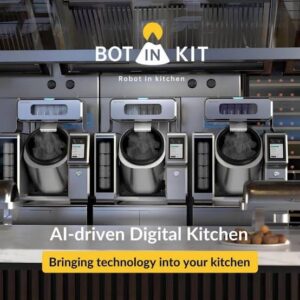

What if your signature dish tasted exactly the same in every province, without a master chef standing at every station? Most Canadian operators realize that a static PDF cookbook is no longer enough to prevent seasoning errors or high food waste during a peak Friday night rush. You’ve likely felt the frustration of inconsistent flavour profiles across different shifts or the struggle of training new staff on intricate steps. A truly effective digital recipe management system must do more than store instructions; it must execute them with mechanical precision.
Discover how to transition from static digital cookbooks to integrated recipe execution systems that ensure flavour consistency across every location. This article, brought to you by Cognitron Robotics, will explore how cutting-edge, hardware-integrated solutions eliminate human error, reduce reliance on specialized labour, and protect your margins against the 4% to 6% food inflation projected for 2026. We’ll preview the future of automated stir-frying and seasoning, turning your intellectual property into a repeatable, high-performance reality for your national operation.
Key Takeaways
- Transition from static digital cookbooks to a dynamic digital recipe management system that serves as a high-performance operating system for your entire kitchen.
- Synchronize your menu across every Canadian location instantly to ensure total flavour consistency regardless of staff turnover or shift timing.
- Learn how to audit “chef’s intuition” and standardize your recipes using precise weight-based measurements to prepare your operation for robotic execution.
- Identify the hidden costs of manual recipe execution and discover how hardware integration significantly reduces ingredient waste and labour reliance.
- Explore how your digital recipes can power automated kitchen equipment, enabling precise stir-frying and seasoning with absolute repeatability.
Beyond the Digital Cookbook: Defining Modern Recipe Management
Think of a professional digital recipe management system as more than a storage folder for kitchen instructions. It’s the operating system of a modern commercial kitchen. While many operators still rely on static PDFs or shared spreadsheets, these tools are essentially digital paper. They’re passive. In a high-volume Canadian franchise environment, passive tools fail to ensure consistency. They don’t communicate with the equipment, they don’t prevent seasoning errors, and they can’t stop a line cook from skipping a crucial step during a busy lunch rush.
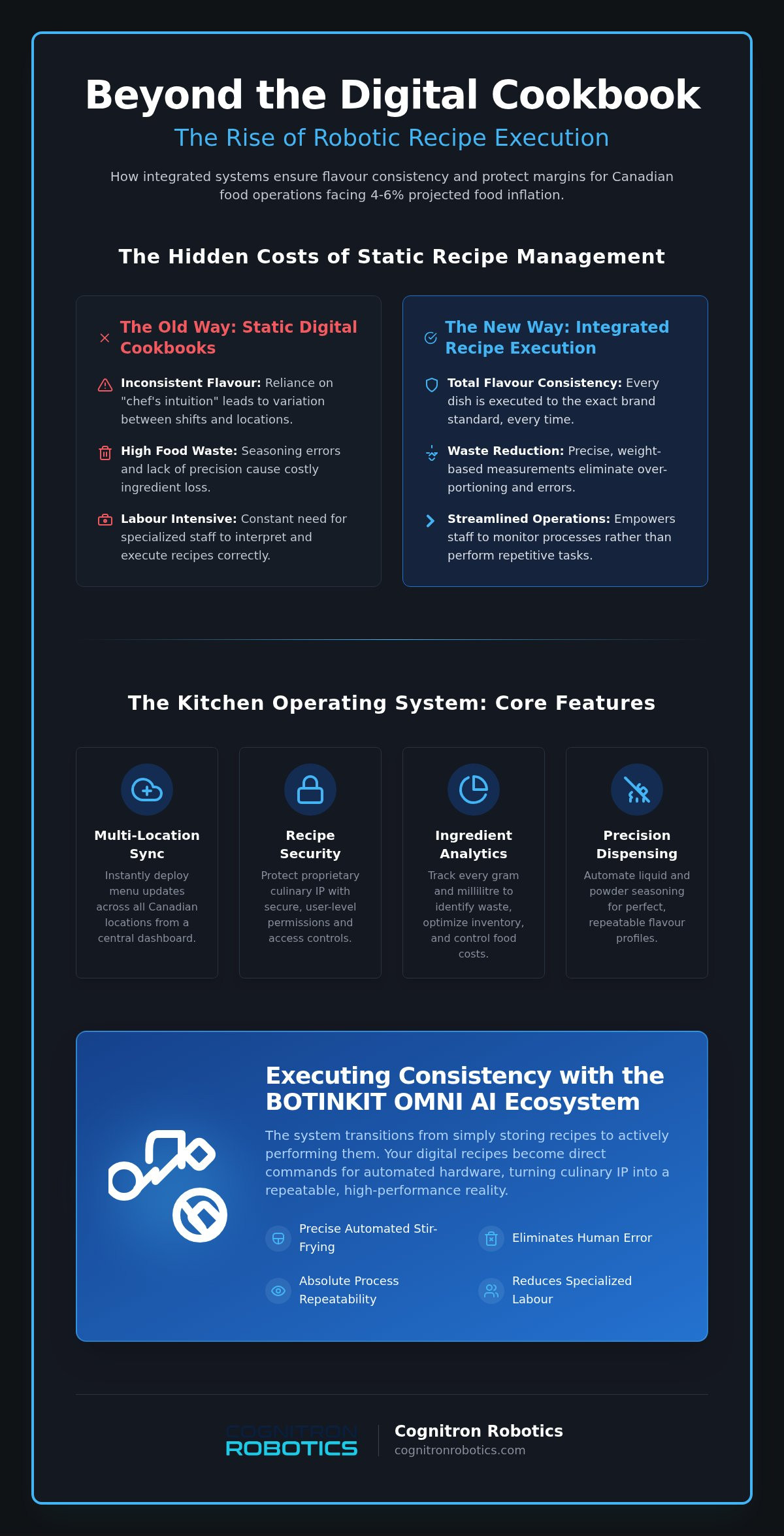
True modernization requires a shift toward “Active Execution.” In this model, the system doesn’t just show a recipe; it guides or performs the cooking process itself. This centralized control is vital for brands operating across multiple provinces. When a head office updates a sauce profile, that change should reflect instantly in every kitchen from the Atlantic to the Pacific. This removes the “chef’s intuition” variable that often leads to inconsistent flavour profiles across different shifts and locations.
The Limitations of Consumer-Grade Apps
Consumer apps like Paprika or basic cloud docs like Google Drive aren’t built for the rigours of a professional cook-line. They create dangerous data silos where information is disconnected from the actual cooking hardware. These tools lack the capability for real-time inventory tracking or ingredient dispensing feedback. If a staff member uses the wrong ratio of oil or salt, a consumer-grade app has no way to detect or correct the error. This lack of integration leads to higher food waste and a constant reliance on specialized labour to interpret the vague instructions often found in manual cookbooks.
The Shift to Integrated Kitchen Intelligence
The rise of the automated restaurant has ushered in a new era of integrated kitchen intelligence. By 2026, technology allows for cloud-based recipe updates that sync across a national fleet in seconds. This isn’t just about text on a screen. AI now plays a proactive role in optimizing cooking temperatures and seasoning timing based on real-time sensor data. Operators are transitioning from the traditional task of “reading a recipe” to the more efficient role of “monitoring a process.” This evolution empowers your team to focus on hospitality while the digital recipe management system handles the repetitive, technical precision required for perfect repeatability.
Essential Features of a Commercial-Grade Digital Recipe System
A professional digital recipe management system functions as the bridge between culinary vision and mechanical execution. While basic apps focus on storage, commercial-grade platforms prioritize functionality that directly impacts the bottom line. This begins with multi-location synchronization. When a central culinary team refines a dish, the update must propagate across the entire national fleet instantly. This ensures that every chef, regardless of their location or experience level, is working from the same “source of truth.”
Beyond simple instructions, these systems offer robust security through user-level permissions. Protecting proprietary culinary secrets is vital for maintaining a competitive edge. By controlling who can edit or view specific formulations, franchises safeguard their intellectual property while still allowing staff to access the operational data they need. This security is paired with detailed analytics. With food costs up 37% on average for Canadian full-service operators, identifying ingredient usage patterns is essential. Integrated systems track every gram and millilitre, highlighting discrepancies that indicate food waste or portioning errors.
Precision Seasoning and Dispensing Controls
The true heart of consistency lies in precision seasoning dispensing systems. Traditional kitchens rely on “tasting as you go,” a method that is subjective and prone to human error. Digital recipes now control liquid and powder additions with millilitre-perfect accuracy. This level of exactness is critical for high-volume stir-fry operations where even a minor seasoning variance can alter the brand’s signature profile. By automating the dispensing process, kitchens reduce their reliance on specialized labour and ensure that every dish meets the same rigorous standard of repeatability.
Cloud-Based Scaling for Canadian Franchises
Scaling a brand across Canada requires more than just opening new doors; it requires standardizing the experience. Modern cloud-based systems allow operators to update a seasonal menu across 100 locations with a single click. These platforms account for different kitchen environments by standardizing cooking times and heat levels through AI-driven adjustments. This ensures the brand flavour remains identical from coast to coast. As you look to optimize your operations, you can explore how hardware integration turns these digital instructions into physical reality, creating a streamlined workflow that thrives in the demanding 2026 market.
Comparing Consumer Apps vs. Integrated Robotic Execution
Choosing between a free consumer app and a professional digital recipe management system is a decision that defines your operational ceiling. While tools designed for home cooks focus on family sharing or aesthetics, they offer zero utility for a high-volume Canadian kitchen. The $0 price tag of a spreadsheet or a basic app is a mirage. It masks the massive hidden costs of manual execution: inconsistent flavour, excessive ingredient waste, and a constant reliance on expensive, specialized labour.
In the high-stakes environment of a Canadian ghost kitchen, profitability hinges on precision. When labour costs exceed 35% of gross revenue, sustainability becomes nearly impossible. Passive recipe storage cannot prevent a line cook from over-seasoning a dish or using too much oil. Integrated robotic execution, however, transforms instructions into automated physical actions. It moves your operation from a reactive model to a proactive one where the hardware ensures every dish matches the master profile perfectly.
Labour Efficiency and Training Requirements
The current Canadian hospitality labour shortage has made staff retention and training a primary pain point. Traditional training for a complex stir-fry station can take weeks of supervision. A hardware-integrated system reduces this timeline from weeks to mere hours. Given the substantial investment in labour costs across Canadian hospitality, every hour saved in training directly protects your margins. Technology empowers junior staff to produce five-star results with minimal oversight. It liberates your senior chefs to focus on creative menu development rather than repetitive monitoring of basic cooking steps.
Ingredient Accuracy and Waste Reduction
Precision is the only effective hedge against the 4% to 6% food inflation projected for 2026. Manual portioning is inherently flawed. Even a small over-pour of high-value oils or seasonings adds up to thousands of dollars in lost profit across a national franchise. Implementing automatic ingredient dispensing systems provides a level of exactness that human hands cannot replicate. These systems track every drop in real-time, providing the data-centric transparency needed to audit inventory and eliminate the financial leak of over-portioning.
How to Standardize Your Menu for Digital Automation
Transitioning to a digital recipe management system requires a fundamental shift in how you document culinary processes. Many traditional recipes rely heavily on “chef’s intuition,” using vague instructions like “cook until golden” or “season to taste.” While these work in a single-chef kitchen, they’re the primary cause of inconsistency in a national franchise. Standardizing for automation begins with an audit of these manual steps to convert them into data points that a machine can execute with absolute repeatability.
You must define specific temperature thresholds and agitation speeds for every cooking stage. Instead of “stir occasionally,” a digital system requires a specific rotations-per-minute (RPM) value. This level of detail ensures that the heat transfer remains identical whether the dish is prepared at noon or midnight. Once these parameters are set, you must test the digital version against the manual original to achieve perfect flavour parity. Only after this verification should you deploy the recipe to your fleet of automated cooking stations.
The Importance of Weight-Based Precision
Volumetric measurements are notoriously unreliable in a high-volume commercial environment. The amount of salt in a “pinch” varies by the person, and even a “cup” of flour can vary in mass depending on how it’s packed. For a digital system to function correctly, every ingredient must be converted to weight-based or millilitre-based units. A “pinch of salt” must become exactly “1.5 grams.” This precision eliminates human error and ensures that your ingredient costs remain predictable. When you remove the variability of hand-pouring, you achieve consistent results regardless of the operator’s experience level.
Building Your Digital Recipe Library
A well-organized digital library is the foundation for future menu expansions. You should categorize your recipes by meal type, prep time, or ingredient commonality to streamline kitchen operations. Security is equally important. Protecting your brand’s “secret sauce” is easier when recipes are stored with secure digital encryption. This prevents unauthorized access to your intellectual property while allowing your kitchens to function at peak efficiency. As you prepare your menu for the future, you can standardize your operations with BOTINKIT OMNI to turn these digital instructions into a physical reality that scales across Canada.
By treating your recipes as precise software code rather than loose suggestions, you protect your brand’s reputation for quality. This meticulous approach to standardization allows you to maintain high standards even as you face the ongoing Canadian hospitality labour shortage. It turns your culinary vision into a repeatable, high-performance asset that drives profitability across every location.
Executing Consistency with BOTINKIT OMNI’s Digital Ecosystem
The BOTINKIT OMNI represents the ultimate evolution of the digital recipe management system. While previous sections established how to standardize data and audit your menu, this hardware platform provides the physical engine to execute those instructions. It’s the premier solution for Canadian operators who refuse to compromise on quality while scaling their brands. By integrating stir-frying, seasoning, and ingredient dispensing into a single automated workflow, the OMNI removes the volatility of human error from the cooking line. It turns your intellectual property into a repeatable, high-performance reality.
This ecosystem modernizes Canadian food service by transforming the kitchen from a place of manual guesswork into a centre of technological precision. The OMNI doesn’t just store your recipes; it interprets them through advanced sensors and AI. This ensures that the heat, timing, and seasoning are adjusted in real-time to maintain flavour consistency. We invite you to see the future of precision cooking in action, where the gap between culinary vision and operational execution is finally closed.
The BOTINKIT OMNI Advantage
The OMNI AI learns and perfects your signature stir-fry techniques with sophisticated accuracy. It doesn’t just mimic movement; it optimizes the process. The transition from digital instruction to physical dish is seamless, allowing for a level of repeatability that manual cooking cannot match. This ensures every plate meets your highest standards of flavour and quality. You’re no longer relying on the unique skills of a single chef at a single location. Instead, you’re deploying a standardized excellence across your entire fleet.
Future-Proofing Your Commercial Kitchen
Staying competitive in the 2026 Canadian market requires a proactive approach to automation. As labour costs and food inflation continue to challenge traditional models, the ability to scale your concept faster than manual kitchens becomes a decisive advantage. Automation allows you to maintain high standards without the constant pressure of specialized staff recruitment. It bridges the gap between culinary creativity and operational reality, allowing your brand to grow without losing its soul. By adopting an integrated digital recipe management system paired with BOTINKIT hardware, you’re not just buying a tool; you’re investing in a future where precision drives profitability.
The result is a streamlined operation that thrives under pressure. You gain the freedom to innovate your menu while knowing the execution is handled with mechanical exactness. This is the new standard for the Canadian franchise industry: a perfect harmony of human creativity and robotic reliability.
The Future of Precision Kitchen Execution
The transition from passive digital cookbooks to an integrated digital recipe management system is no longer a luxury for Canadian operators. It’s a strategic necessity. By standardizing your menu through weight-based precision and AI-driven thresholds, you protect your culinary intellectual property and ensure a flawless guest experience. You’ve seen how hardware integration moves beyond simple storage to become the physical engine of your kitchen. This technology allows you to scale your brand across Canada with total consistency, regardless of local labour challenges.
The BOTINKIT OMNI empowers your team to eliminate human error in seasoning while maintaining peak efficiency. This precision allows you to reduce ingredient waste by up to 15%, directly strengthening your margins in a demanding market. Embracing this level of automation doesn’t replace the chef’s creativity; it liberates it from the burden of repetitive monitoring. It’s time to modernize your workflow and secure your operational future.
Book a demo of the BOTINKIT OMNI digital execution system today and lead your kitchen into the next era of culinary excellence.
Frequently Asked Questions
What is a digital recipe management system for restaurants?
A digital recipe management system is a centralized platform that stores, organizes, and executes culinary instructions through integrated hardware. Unlike a static PDF, it acts as the operating system for your kitchen by controlling cooking parameters like temperature and seasoning. It ensures that every station follows the exact same source of truth. This turns your intellectual property into a repeatable process that maintains quality across your entire franchise fleet, ensuring brand standards are met every time.
How does digital recipe management improve flavour consistency?
Consistency is achieved by eliminating the subjective chef’s intuition that often leads to variance between shifts. The system dictates precise seasoning amounts and cooking times down to the millilitre and second. By removing manual measurement errors, the brand’s signature flavour profile remains identical regardless of who is operating the equipment. This mechanical precision ensures that a dish prepared in the morning tastes exactly like one served at the end of the night, across all locations.
Can a digital recipe system integrate with my existing kitchen equipment?
While some software-only systems offer limited compatibility, true digital recipe management reaches its peak when paired with dedicated hardware like the BOTINKIT OMNI. This system is designed as an all-in-one solution that integrates stir-frying, seasoning, and dispensing. It creates a closed-loop ecosystem where the digital instructions directly drive the physical cooking process. This ensures that your existing workflows are enhanced by automated reliability and data-driven precision, rather than just being documented in a passive app.
Is it difficult to convert my manual recipes into a digital format for robots?
The conversion process involves auditing your current recipes to replace vague terms with precise data points. You’ll move from volumetric measures to weight-based or millilitre-based units. While this requires an initial investment in standardization, the result is a scalable digital library that can be deployed instantly. This transition ensures your recipes are optimized for robotic execution. It makes your menu items immune to the variability of human interpretation and the errors associated with manual handling in busy kitchens.
How do digital recipe systems help with Canadian labour shortages?
Automation addresses the Canadian hospitality labour shortage by reducing the reliance on specialized, hard-to-find culinary talent. Training time for new staff is often reduced from weeks to mere hours, as the system handles the technical complexities of stir-frying and seasoning. This allows junior employees to produce high-quality results with minimal supervision. It protects your operations from the impact of high turnover and rising minimum wage pressures while allowing your senior staff to focus on creativity.
What is the difference between a recipe app and an execution system?
A recipe app is a passive storage tool used for viewing text or images. In contrast, a digital recipe management system designed for execution is an active engine that controls the actual cooking hardware. It doesn’t just show you how to cook; it performs the seasoning, temperature control, and agitation. This distinction is critical for franchises because a storage app cannot prevent seasoning errors, reduce physical food waste, or ensure that every dish meets precise brand standards.
Can I update recipes across multiple locations simultaneously?
Yes, centralized cloud-based control allows you to update your entire menu across every Canadian location with a single click. When your head office refines a sauce profile or adjusts a cooking time, the update propagates instantly to every connected station. This eliminates the need for manual retraining at individual sites. It ensures that seasonal menu changes or quality improvements are implemented uniformly across your national fleet, maintaining total control over your brand’s culinary output.
Does the BOTINKIT OMNI require a professional chef to operate?
The BOTINKIT OMNI is designed to be operated by general kitchen staff after minimal training. While a professional chef is essential for the creative development and initial digitization of recipes, the day-to-day execution is handled by the automated system. This empowers your junior team to deliver five-star results consistently. It frees your senior culinary talent to focus on innovation and high-level management rather than the repetitive, manual cooking tasks that often lead to burnout and inconsistency.