Can a commercial cooking robot apply seasoning consistently while keeping culinary judgement in your team’s hands? For operators considering commercial cooking robot automated seasoning, that’s the practical test: whether automation can repeat recipe instructions reliably and fit the pace of service.
Seasoning can differ between cooks and shifts, while manual steps add pressure during busy periods. A recipe-led workflow can help standardize repeatable tasks without replacing the people who oversee quality, taste and service. The BOTINKIT OMNI combines automated seasoning with ingredient dispensing, stirring, temperature control and digital recipe management for commercial stir-frying.
This guide explains how automated seasoning works within that cooking process and what to assess before adopting it. You’ll consider whether recipe-led automation suits your menu and service model, which workflow and site requirements to review, and how to evaluate the OMNI for your operation. That includes checking electrical needs and confirming site-specific utility and installation details with the Cognitron Robotics team before moving forward.
Key Takeaways
- See how commercial cooking robot automated seasoning can help make seasoning more repeatable across cooks and shifts.
- Understand how digital recipes work with Auto Seasoning, Auto Stir and Auto Temperature Control during a cooking cycle.
- Compare programmed repeatability with manual control to assess where automation can support your team’s culinary judgement.
- Review menu fit, production patterns, staff workflow, space, utilities and ventilation before planning an installation.
- Explore whether the BOTINKIT OMNI’s automated stir-frying workflow suits your menu, including dishes from cuisines such as Italian, Mexican, Thai, Korean and Indian.
What does automated seasoning mean in a commercial cooking robot?
Automated seasoning applies seasoning according to programmed instructions as part of a cooking process. In a commercial cooking robot, those instructions can form one step in a recipe-led sequence, alongside tasks such as ingredient dispensing, stirring and temperature control. The goal is repeatable execution, not a promise that every dish will be identical under every kitchen condition.
The phrase commercial cooking robot automated seasoning describes one defined capability, not the whole cooking workflow. Seasoning automation concerns how a seasoning step is carried out. Full cooking automation can coordinate multiple cooking actions, while digital recipe management stores or distributes recipe instructions and parameters. These functions can work together, but they are not interchangeable.
How automated seasoning fits into commercial food preparation
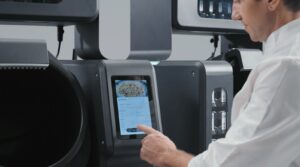
In a commercial kitchen, automated seasoning is the application of seasoning according to programmed recipe instructions during food preparation. It is one part of a wider sequence: a team prepares ingredients, selects a recipe and starts the cooking cycle, while the system carries out its programmed steps. BOTINKIT OMNI brings Auto Seasoning into a commercial stir-frying workflow that also includes ingredient dispensing and digital recipe management.
This sits within the broader idea of restaurant automation, where technology can take on defined operational tasks. Programming supports consistency by giving staff a shared process to follow. It doesn’t remove the need for people to prepare ingredients, oversee cooking, assess the finished dish or decide when a recipe needs adjustment.
For an overview of the system’s commercial cooking role and capabilities, see the BOTINKIT OMNI commercial cooking robot page.
Why seasoning consistency matters during service
When different cooks prepare the same menu item, seasoning can vary with individual technique, the pace of service and how closely each person follows a recipe. Those differences can also emerge between shifts or across repeated orders. A programmed instruction gives the team a common reference for the seasoning step, reducing reliance on each cook remembering or estimating it independently.
That reference has practical value during busy service: staff can follow an established recipe process while keeping attention on preparation, timing and quality checks. Still, a programmed step doesn’t control every factor that can affect the result. Ingredient preparation, recipe settings and human oversight remain part of the workflow. Automated seasoning supports kitchen teams by making a repeatable task more structured; culinary judgement stays with the people responsible for the dish.
How a commercial cooking robot coordinates automated seasoning
In the BOTINKIT OMNI, seasoning is one programmed step within a broader automated stir-frying workflow. Digital recipe management controls and distributes recipe instructions and parameters, while ingredient dispensing, Auto Seasoning, Auto Stir and Auto Temperature Control coordinate parts of the cooking cycle. Together, these functions give staff a consistent process to follow, with people still responsible for ingredient preparation and reviewing the finished dish.
From a digital recipe to an automated cooking cycle
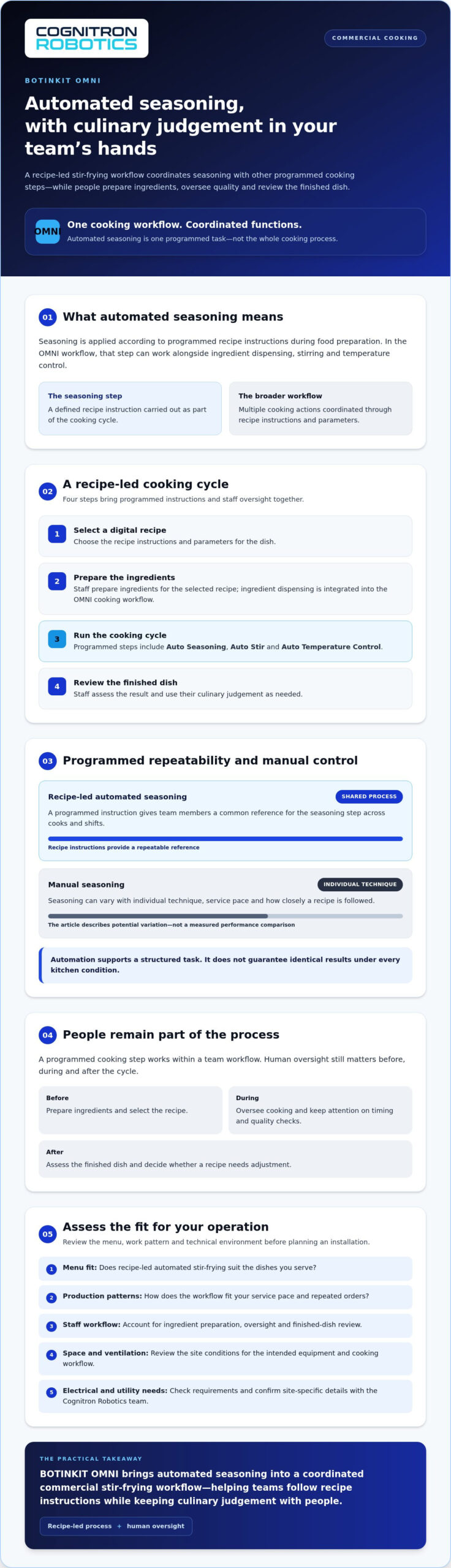
A practical workflow follows four steps:
- Select a digital recipe: The team chooses the recipe instructions and parameters for the dish.
- Prepare the ingredients: Staff prepare the ingredients for the selected recipe. OMNI’s ingredient dispensing is an integrated part of its cooking workflow.
- Run the cooking cycle: The system carries out programmed steps, including seasoning, stirring and temperature control.
- Review the result: Staff assess the cooked dish and apply their culinary judgement as needed.
This sequence can help different team members follow the same recipe process, but it doesn’t guarantee identical results. Ingredient preparation and human review remain part of the work. For a broader explanation of the equipment and process, see The Complete Guide to the Automated Stir-Fry Cooking System in 2026. The Brookings overview of technology’s impact on the food industry offers wider context on automation in food service.
What the confirmed OMNI features do
Each named function has a distinct role in the cooking sequence. Auto Seasoning applies seasoning according to programmed recipe instructions. Auto Stir handles stirring during cooking, while Auto Temperature Control manages temperature as part of the cycle. Combined, these confirmed functions support the OMNI’s automated stir-frying workflow by coordinating seasoning, stirring and temperature control around recipe instructions.
OMNI also lists Auto Dishing Up and Auto Cleaning as product features. The auto voice guide is another listed feature. These names describe capabilities, but operators should confirm how each applies to their menu and workflow rather than assume unlisted functions.
For teams assessing commercial cooking robot automated seasoning, the key is to map each recipe step to the system’s confirmed capabilities and decide where staff preparation, oversight and review remain essential. To discuss how the OMNI workflow could fit your operation, contact the Cognitron Robotics team.
Automated versus manual seasoning: how to assess the right fit
Choosing between manual and automated seasoning depends on the recipe, service pattern and level of repeatability your team needs. A commercial cooking robot automated seasoning workflow can standardize programmed steps, but it won’t solve every kitchen challenge or make culinary decisions for staff. Use the comparison below to identify where each approach fits your operation.
| Consideration | Programmed seasoning | Manual seasoning |
|---|---|---|
| Repeatability | Follows programmed recipe instructions for the seasoning step. | Depends on the cook’s technique and how they interpret the recipe. |
| Human oversight | Staff prepare ingredients, monitor the process and assess the result. | The cook applies seasoning and makes adjustments directly. |
| Workflow demands | Requires suitable recipes, preparation routines and a cooking cycle that fits service. | Requires staff time and attention at the seasoning step. |
| Menu fit | Best assessed against repeatable dishes and the system’s confirmed functions. | Can suit dishes that call for frequent adjustment or individual technique. |
Which cooking tasks may suit automation?
Repeatable stir-fry preparation and batch cooking may be candidates when recipes use defined instructions and fit the system’s workflow. The BOTINKIT OMNI supports up to 30 portions per batch. That figure is a capacity reference, not a recommendation for every menu item or service period. Assess actual recipes, portion needs, order patterns and preparation routines before deciding whether programmed cooking supports your operation.
A robot doesn’t independently resolve staffing, menu complexity, ingredient preparation or service coordination. Automation is most relevant when it addresses a specific repetitive step without adding friction elsewhere in the kitchen.
Where people remain central to the kitchen
People continue to make menu decisions, prepare ingredients, oversee service and judge the finished dish. Automation can take on defined, repetitive cooking tasks; it doesn’t replace culinary experience or adapt a recipe beyond its programmed instructions. A practical assessment should identify which steps the system performs and which remain the team’s responsibility.
For a focused discussion of dispensing, see Precision Seasoning: How Digital Dispensing Elevates Taste. Use that information alongside your own recipes and service patterns to decide whether programmed seasoning complements your team’s approach.
What to check before adding an automated seasoning robot
A commercial cooking robot automated seasoning workflow needs to fit the menu and the physical kitchen, not just the recipe. Before choosing equipment, review which dishes suit programmed cooking, how orders move through service, what staff will prepare and oversee, and whether the intended location can accommodate the unit and its utility requirements.
Review the technical environment and site requirements
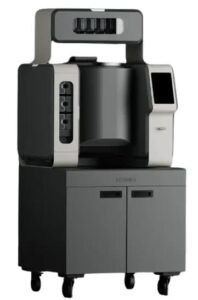
Use the confirmed specifications as a starting point for a site review, not as a substitute for checking your kitchen. BOTINKIT OMNI measures 1,769 mm high, 827 mm wide and 920 mm deep. Allow the team and equipment to work within the planned space, and verify placement alongside the kitchen’s ventilation and utility arrangements.
- Electrical configuration: The recommended electrical box configuration is 220 V, 3-Phase, 5-wire. Confirmed maximum electrical power specifications are 12 kW (24 A) and 15 kW (30 A), with 2 kW per OMNI unit.
- Water pressure: The stated requirement is 200-350 kPa.
- Ventilation: The stated hood exhaust air volume is above 3,000 m³/h per OMNI unit.
These figures do not establish that a particular site is ready. Confirm utility capacity, ventilation, equipment placement and installation requirements with the provider before making plans. this product supports the electrical requirements of different countries and regions; specific specifications may vary by sales area.
Plan the workflow before equipment selection
Map a typical order from start to finish: recipe selection, ingredient preparation, cooking, dishing up and staff oversight. Note where team members need access, how the cooking cycle fits service peaks, and whether your menu includes repeatable dishes suited to the system’s functions. This helps identify workflow changes or space constraints early.
Then review the proposed location and utility connections with the provider. Ask them to confirm whether the site’s electrical setup, water pressure and hood exhaust arrangements match the relevant specifications for your sales area. For further product and workflow context, read BOTINKIT OMNI: The Definitive Guide to Commercial Cooking Automation in 2026.
To review your kitchen’s requirements and discuss whether the OMNI fits your operation, contact the Cognitron Robotics team.
How the BOTINKIT OMNI brings automated seasoning into commercial cooking
The BOTINKIT OMNI is a commercial cooking robot for automated stir-frying, combining seasoning and ingredient dispensing with recipe-led cooking functions. Its role is to carry out programmed steps consistently, giving teams a structured process for suitable dishes while leaving menu decisions, ingredient preparation and quality review in human hands.
OMNI supports recipes across cuisines including Italian, Mexican, Thai, Korean and Indian. That range can be useful for operators reviewing whether a cooking robot fits an existing menu, but cuisine alone doesn’t determine fit. Consider the specific recipes, preparation routines, batch sizes and pace of service you need to support.
Match OMNI capabilities to your menu and service model
Auto Seasoning applies seasoning as part of the programmed cooking process, while digital recipe management organizes recipe instructions and parameters. Together, they can support repeatable execution of recipes that suit automated stir-frying. OMNI supports cooking from a single portion up to 30 portions at once. Review your own dishes and order patterns to see whether that range aligns with production needs.
For product details, explore the BOTINKIT OMNI commercial cooking robot. Use the listed functions as a starting point for a practical menu assessment, not as a substitute for testing recipe suitability and planning staff oversight.
Confirmed Carbonara examples illustrate how cooking time varies with the specified batch: 400 g for one portion takes 3 minutes; 4 kg for 10 portions takes 6 minutes; and 8 kg for 20 portions takes 8 minutes. These examples apply to Carbonara and shouldn’t be treated as timings for other recipes. Confirm the requirements for the dishes you plan to prepare.
Take the next step with a workflow discussion
Before contacting the team, prepare a short list of your priority menu items, typical batch sizes, service patterns and staffing workflow. Include questions about the site’s available space, utilities and ventilation so the discussion can address both recipe fit and technical requirements. Clear operational details help you assess how automated seasoning may fit your kitchen without assuming a specific result or implementation outcome.
Discuss your commercial cooking workflow with Cognitron Robotics, including your recipes, production needs and site requirements.
Bring repeatable cooking into your workflow
Automated seasoning works best as part of a recipe-led cooking process that fits your menu, service pattern and kitchen setup. The commercial cooking robot automated seasoning workflow can help teams follow programmed recipe instructions, while staff retain responsibility for ingredient preparation, oversight and the finished dish.
BOTINKIT OMNI combines Auto Seasoning and Auto Stir with digital recipe management for commercial stir-frying. BOTINKIT reports over 6,000 units shipped and over 64 million dishes prepared. Those figures provide context for the system’s use, while your own recipes, batch patterns and site requirements remain central to assessing fit.
Have questions ready about the dishes you want to prepare, the team’s workflow, production volumes and technical environment. Discuss your commercial cooking workflow with Cognitron Robotics and review how the OMNI’s confirmed capabilities align with your operation. With a clear assessment, your team can consider automation as practical support for consistent, people-led cooking.
Frequently Asked Questions
What is automated seasoning in a commercial cooking robot?
Automated seasoning applies seasoning according to programmed instructions as part of a cooking process. In BOTINKIT OMNI, Auto Seasoning works within automated stir-frying alongside functions such as Auto Stir and Auto Temperature Control. This can help teams follow a repeatable recipe process, but it doesn’t guarantee identical results or mean every dish is suitable. Assess your recipes, ingredients and kitchen workflow before deciding whether the function fits your menu.
How does a commercial cooking robot automate seasoning?
A commercial cooking robot follows programmed recipe instructions during a cooking cycle. OMNI combines Auto Seasoning with Auto Stir and Auto Temperature Control as part of its automated stir-frying workflow, alongside ingredient dispensing and digital recipe management. Staff still prepare ingredients, oversee the cooking process and review the dish. The sequence and suitability depend on the recipe and operating setup, so discuss your menu and workflow with the provider.
Can a cooking robot maintain consistent seasoning across batches?
A cooking robot can follow programmed recipe instructions to support repeatable preparation, but it can’t guarantee identical results across batches. OMNI combines digital recipe management with Auto Seasoning within its cooking workflow. Ingredients, recipe settings and operating conditions can affect the result. Review the dishes you plan to prepare, including how ingredients are prepared and how the team will oversee each cycle, before deciding whether automated seasoning suits your operation.
Does automated seasoning replace chefs or kitchen staff?
No. Automated seasoning supports a cooking workflow; it doesn’t remove the need for people. Kitchen teams continue to make menu decisions, prepare ingredients, oversee cooking and manage service. Automation may help with repetitive, programmed tasks, while staff retain responsibility for culinary judgement and the finished dish. A practical assessment identifies which steps the system can perform and which require the knowledge and attention of your team.
What types of dishes can BOTINKIT OMNI prepare?
Confirmed examples include Carbonara, Aglio e Olio, Pad Thai, fajitas, butter chicken and sweet and sour chicken. These dishes represent examples from Italian, Thai, Mexican, Indian and Chinese cuisines. They don’t establish that every recipe from those cuisines, or every menu item, is compatible. Review the recipes, ingredients and service pattern you have in mind with Cognitron Robotics to assess whether they fit OMNI’s commercial stir-frying workflow.
What are the electrical and ventilation requirements for BOTINKIT OMNI?
The recommended electrical box configuration is 220 V, 3-Phase, 5-wire. Listed maximum electrical power specifications are 12 kW (24 A) and 15 kW (30 A); each unit requires 2 kW. Hood exhaust air volume must be above 3,000 m³/h per unit. Confirm site suitability and the applicable specifications with the provider. this product supports the electrical requirements of different countries and regions; specific specifications may vary by sales area.
How many portions can BOTINKIT OMNI cook at once?
BOTINKIT OMNI supports single servings up to 30 portions at once. Confirmed Carbonara examples are 400 g for one portion in 3 minutes, 4 kg for 10 portions in 6 minutes, and 8 kg for 20 portions in 8 minutes. These are specific examples, not cooking-time promises for other dishes or batch sizes. Discuss your menu and production needs with Cognitron Robotics to review recipe suitability.