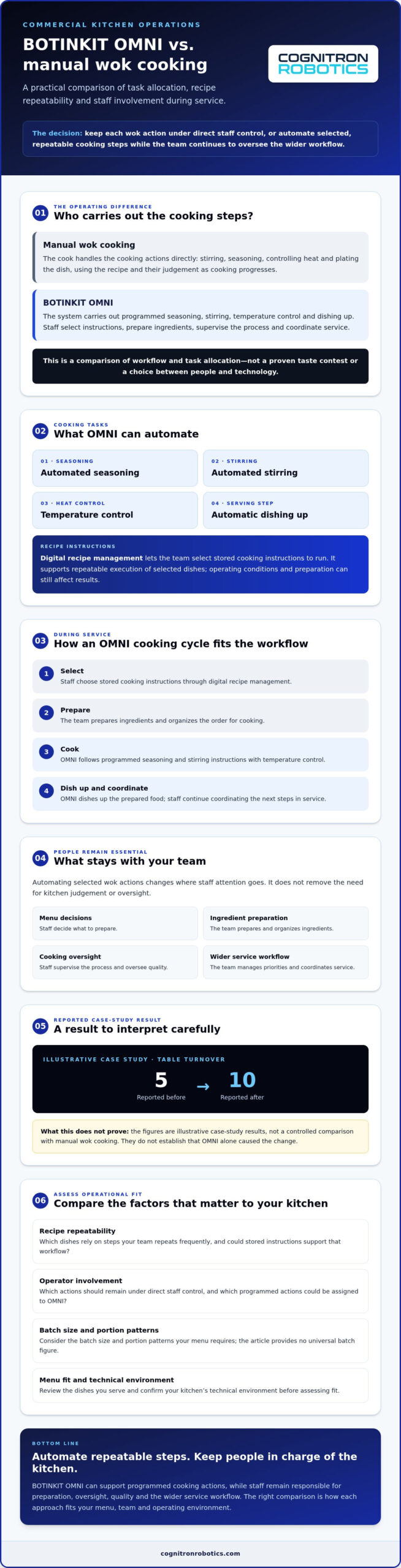
In a commercial kitchen, the Botinkit vs manual wok comparison is less about replacing a chef and more about deciding which repeatable cooking steps to automate. Manual wok cooking keeps each action under the cook’s direct control. BOTINKIT OMNI can carry out programmed cooking tasks while staff continue to prepare ingredients, oversee quality and manage service.
During a busy service, manual wok output can vary with staff skill and execution. OMNI automates seasoning, stirring, temperature control and dishing up, supported by digital recipe management. This changes how tasks are assigned at the wok station, while leaving staff responsible for the broader kitchen workflow.
This article compares the two approaches using practical operating criteria, including recipe repeatability, batch size and operator involvement. It also examines illustrative case study results, which do not establish a controlled comparison with manual wok cooking. You’ll see which tasks OMNI can support, what responsibilities stay with your team, and what to confirm about your kitchen’s technical environment before assessing fit.
Key Takeaways
- Frame Botinkit vs manual wok as a comparison of task allocation and service workflow, not an unsupported taste contest.
- Identify which repeatable cooking steps OMNI can automate and where staff preparation and oversight remain essential.
- Compare manual and automated cooking using practical criteria such as recipe repeatability, operator involvement and batch cooking.
- Interpret the illustrative case study results carefully: reported table turnover rose from 5 to 10, but this does not prove a controlled comparison with manual wok cooking.
- Assess menu fit, portion patterns and your kitchen’s technical environment before deciding whether OMNI suits your operation.
BOTINKIT vs. manual wok cooking: what is the real operational comparison?
The operator’s decision is whether to keep each wok cooking step under direct staff control or automate selected, repeatable actions. That is the practical focus of Botinkit vs manual wok: how work is assigned during service, not which approach tastes better. Taste depends on the dish, ingredients, recipe and execution, so it shouldn’t be treated as a proven advantage of either workflow.
Manual cooking puts the cooking actions in the cook’s hands. BOTINKIT OMNI automates defined steps, while kitchen staff continue to make menu decisions, prepare ingredients, oversee cooking and manage the wider service. This is a task allocation decision, not a choice between people and technology.
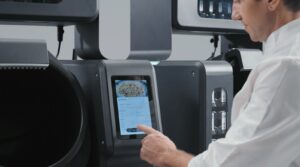
The video offers a visual introduction to OMNI’s role in a commercial kitchen:
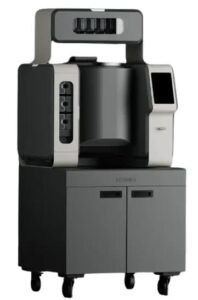
For context, the automated restaurant concept covers a broader range of robotic and automated foodservice tasks. OMNI’s role is more specific: it supports repeatable stir-fry execution. Review the BOTINKIT OMNI commercial cooking robot as a system for automating defined cooking steps while keeping human oversight in the workflow.
What does manual wok cooking ask of a kitchen team?
In a manual workflow, staff handle ingredients, stir the food, season it, control heat and plate the finished dish. The cook performs these actions directly, using the recipe and their judgement as the dish progresses. Skill and execution can affect how consistently steps are repeated, but the degree of variation differs by kitchen, menu and team. During peak service, operators can assess whether their process is repeatable with their staffing and workflow.
What does BOTINKIT OMNI automate?
OMNI automates seasoning, stirring, temperature control and dishing up. Digital recipe management lets a team run stored cooking instructions, supporting repeatable execution of selected dishes. Staff still make menu choices, prepare ingredients, supervise the process and coordinate the rest of service.
Automated wok cooking means using OMNI to carry out programmed seasoning, stirring, temperature control and dishing up, while staff retain responsibility for preparation, oversight and service. This clear division helps operators compare workflows based on the tasks they need to repeat, rather than on assumptions about taste or the value of skilled cooks.
How OMNI changes the manual wok workflow during service
In a manual wok workflow, a cook carries recipe steps through the cooking cycle directly. With OMNI, the team assigns selected, repeatable cooking actions to the system while retaining control of preparation, supervision and service priorities. This changes where staff attention goes during a rush. It doesn’t remove the need for kitchen judgement.
Here’s how an OMNI cycle can fit into service:
- Select: Staff choose stored cooking instructions through digital recipe management.
- Prepare: The team handles ingredient preparation and organizes the order for cooking.
- Cook: OMNI carries out programmed seasoning and stirring, with automatic temperature control.
- Dish up: OMNI automatically dishes up the prepared food, while staff continue coordinating the next steps in service.
From recipe instructions to automated cooking
Digital recipe management gives staff a way to select and run stored instructions rather than manually repeating each cooking action. Automated seasoning and stirring reduce reliance on continuous manual execution for those steps. The system supports a defined process and can help teams repeat recipe instructions, though results can still be affected by operating conditions and preparation.
OMNI takes a stored recipe from automated seasoning and stirring through temperature control to automatic dishing up.
This task based approach sits within the broader discussion of widespread automation in the food service industry. For operators, the practical question is which parts of a wok station’s cooking cycle are suitable for programmed execution and which need staff direction.
Where kitchen staff remain essential
Staff prepare ingredients, select the appropriate recipe, monitor operations and respond to changing service priorities. They also make menu decisions and manage the wider kitchen workflow. OMNI supports repetitive cooking actions. It does not take over these responsibilities or guarantee identical results in every condition.
That division can help an operator plan how orders move through the wok station: staff direct the work, while the system performs the specified cooking sequence. To assess how the BOTINKIT OMNI cooking robot could fit your menu and service pattern, review its confirmed capabilities and discuss your technical environment with the product provider.
Manual wok vs. BOTINKIT OMNI: compare the decision criteria
A useful Botinkit vs manual wok assessment looks at who performs each task, how recipe instructions are repeated and whether the cooking workflow suits your order patterns. The comparison below describes the operating models without assuming that every kitchen faces the same constraints or that automation guarantees better results.
| Decision criterion | Manual wok cooking | BOTINKIT OMNI |
|---|---|---|
| Task execution | Staff directly handle cooking actions such as stirring, seasoning and heat control. | Automates seasoning, stirring, temperature control and dishing up. |
| Recipe repeatability | Staff follow the recipe and apply their judgement throughout the cooking process. | Digital recipe management runs stored instructions, supporting repeatable execution. |
| Operator involvement | The cook performs the cooking steps directly, alongside preparation and service duties. | Staff prepare ingredients, select recipes, oversee operations and manage the wider service. |
| Batch cooking | Portion sizes and batch workflow depend on the kitchen’s chosen process. | Supports cooking from a single serving up to 30 portions per batch. |
Which workflow offers more repeatable recipe execution?
Manual cooking gives the cook direct control over each step. OMNI instead uses digital recipe management and automated cooking functions to carry out stored instructions. That can make the programmed sequence easier to repeat, but it doesn’t guarantee identical sensory results. Ingredients, preparation, recipe settings and service conditions still affect the dish. Assess whether your priority is direct hands on control or consistent execution of defined steps.
How should operators assess batch cooking and staff involvement?
OMNI supports cooking from a single serving up to 30 portions at once. Compare that range with the portions your menu requires and the way orders arrive during service. Manual batch cooking also depends on the kitchen’s chosen workflow, so the relevant question is whether either approach fits your actual production pattern.
Staff remain central to both models. With OMNI, they direct the workflow and oversee the cooking operation, while the system automates specified steps. For a broader evaluation, compare task ownership, recipe control, batch needs and the requirements of your kitchen before deciding which workflow fits.
What the OMNI case-study results show, and what they do not prove
The supplied case study figures are illustrative operational results, not guaranteed outcomes. They do not establish that BOTINKIT OMNI caused the reported changes, and they are not evidence from a controlled Botinkit vs manual wok trial. Treat them as reported results that can guide questions for your own assessment, not as a forecast for your kitchen.
How to interpret the reported operational changes
The illustrative results report daily table turnover rising from 5 to 10, an increase of 100%. They also report monthly revenue increasing from $230,000 to $283,500, an increase of 23%, and labour costs decreasing from $58,106 to $44,199, a decrease of 24%. These figures should be read as reported results, not proof that OMNI caused the changes.
Before relying on any reported result, confirm the measurement period, operating conditions and factors that may have contributed. Without that context, it isn’t possible to determine how much of a change relates to OMNI, other operational changes or differences in the period measured. The reported results also don’t establish that another kitchen would see the same outcome.
What evidence would support a fair manual-wok comparison?
Compare equivalent conditions. Assess the same dishes and portion sizes across comparable service periods, and apply consistent quality checks. Track preparation workflow, completed output, staff involvement and food consistency using the same measures for both methods. Record relevant operating conditions so your team can interpret the findings fairly.
This approach can help clarify whether automated cooking steps change your workflow. It doesn’t establish a taste advantage or prove that OMNI caused an operational change. A before and after result alone can’t show what would have happened under manual wok cooking during the same conditions. Use a consistent comparison to inform your decision, and verify the case study context before drawing conclusions.
Contact Cognitron Robotics to discuss your operation and the measures that matter to your kitchen.
Is BOTINKIT OMNI the right fit for your commercial wok operation?
Fit depends on more than whether your menu includes stir-fry. Assess whether your dishes suit OMNI’s cooking process, whether the supported portion range matches demand, and how the system would work alongside staff during service. The Botinkit vs manual wok decision should reflect your real menu and workflow, not an assumed performance outcome.
A practical pre-purchase fit checklist
- Menu: Identify the stir-fry dishes you want to prepare with OMNI and confirm their recipe requirements with the product provider.
- Portion patterns: Compare expected orders with the confirmed range, from a single serving up to 30 portions per batch. Consider how demand changes across your service periods.
- Recipe repeatability: Decide which dishes rely on stored instructions and repeatable cooking steps, while accounting for ingredient preparation and staff oversight.
- Staff workflow: Map who will prepare ingredients, select recipes, monitor cooking and manage other service priorities. Automation supports defined cooking tasks; it doesn’t remove the need for people to run the kitchen.
- Technical environment: Review the installation requirements with the product provider and qualified project stakeholders before making a fit decision.
Listed electrical details include 220 V, 3-Phase, 5-wire; MAX 12 kW (24 A) and 15 kW (30 A); and 2 kW per OMNI unit. Confirm which configuration applies to your site. Also confirm the water pressure and hood exhaust requirements for your intended installation. Don’t assume electrical, water or exhaust specifications are the same across locations.
This product supports the electrical requirements of different countries and regions; specific specifications may vary by sales area.
How to take the next step with Cognitron Robotics
Before a product discussion, gather your menu priorities, expected service patterns, portion needs and known kitchen constraints. This helps focus the conversation on how OMNI’s cooking functions could fit your operation and which technical details need confirmation. Review the BOTINKIT OMNI product information alongside your requirements.
Use your menu, workflow and technical requirements to guide the discussion with Cognitron Robotics.
Make your next wok decision with confidence
The Botinkit vs manual wok decision is ultimately about workflow: whether staff perform each cooking action directly or assign repeatable steps to automation. OMNI automates seasoning, stirring, temperature control and dishing up, while kitchen staff remain responsible for preparation, oversight and service decisions.
The illustrative results report a 100% increase in daily table turnover and a 24% decrease in labour costs. They are not guaranteed outcomes and don’t establish a controlled comparison between OMNI and manual wok cooking. The product information lists USA & Canada (NA), NSF/ANSI 4, CE, FCM and RCM among its stated certifications. Operators can consider these details as part of their evaluation.
Assess the system against your menu, portion patterns, staff workflow and technical environment. Confirm the applicable configuration and site requirements before deciding whether it fits your operation.
Contact Cognitron Robotics to discuss OMNI for your kitchen and review how its confirmed capabilities align with your service needs.
Frequently Asked Questions
Does BOTINKIT OMNI replace a manual wok cook?
No. OMNI automates selected stir-fry tasks, while kitchen staff continue to prepare ingredients, choose recipes, oversee operations and manage service. The system handles automated seasoning, automated stirring, temperature control and dishing up. This changes how work is assigned at the wok station; it doesn’t remove the human role or replace broader kitchen responsibilities. Operators should assess how those automated steps fit their menu and team workflow.
Can BOTINKIT OMNI cook the same portions as a manual wok?
OMNI supports cooking from a single serving up to 30 portions at once. Whether that matches a manual wok process depends on your recipes, portion sizes and service pattern. Compare the system’s supported batches with actual orders, not an assumed equivalence between cooking methods. For example, the product information includes 400 g, 4 kg and 8 kg examples, but these are specific examples rather than a claim that every recipe uses those batch sizes.
Does an automated wok produce the same flavour as manual cooking?
There isn’t enough information to claim that an automated wok produces exactly the same flavour as manual cooking, or that either method tastes better. OMNI follows stored recipe instructions and automates defined cooking steps, but ingredients, preparation, recipe settings and operating conditions still matter. To evaluate flavour for your menu, compare the same dishes and portion sizes, then apply consistent quality checks rather than relying on assumptions about automation.
How fast can BOTINKIT OMNI cook a batch?
Cooking time depends on the recipe and batch size. In the product information, Carbonara examples list 3 minutes for 400 g, 6 minutes for 4 kg and 8 minutes for 8 kg. These times apply to that dish and those stated quantities; they shouldn’t be treated as cooking times for every menu item. Confirm expected timings for your recipes and workflow with the product provider before planning service around them.
What case-study results are reported for BOTINKIT OMNI?
The illustrative results report daily table turnover rising from 5 to 10, an increase of 100%; monthly revenue increasing from $230,000 to $283,500, an increase of 23%; and labour costs decreasing from $58,106 to $44,199, a decrease of 24%. These figures aren’t guaranteed outcomes and don’t establish a controlled comparison between manual wok cooking and OMNI. Confirm the measurement period, operating conditions and attribution before using the results to assess likely outcomes for another kitchen.
What technical requirements should a commercial kitchen check before installing OMNI?
Confirm the applicable electrical configuration, water pressure and hood exhaust requirements with the product provider and qualified project stakeholders. Listed electrical details are 220 V, 3-Phase, 5-wire; MAX 12 kW (24 A) and 15 kW (30 A); and 2 kW per OMNI unit. Listed water pressure is 200 to 350 kPa, and hood exhaust air volume is > 3000 m³/h per unit. This product supports the electrical requirements of different countries and regions; specific specifications may vary by sales area.
How should a restaurant compare manual wok cooking with automation?
Compare the workflows under equivalent conditions: use the same dishes, portion sizes and service periods, and apply the same quality checks. Track preparation, output, staff involvement and food consistency for both approaches. In the Botinkit vs manual wok assessment, distinguish direct staff control from OMNI’s programmed cooking steps. Review your menu and order patterns, and don’t infer a taste advantage or labour reduction from an uncontrolled comparison.