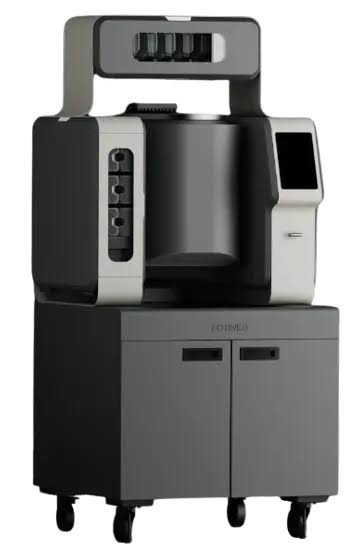
What if the food your kitchen throws away is less a service problem than a visibility problem? Minimizing food waste in commercial kitchens starts with identifying where ingredients are lost, from receiving and storage to preparation and service. When demand shifts and production relies on manual estimates, overproduction, spoilage, and inconsistent portions can be difficult to spot until food is already wasted.
The answer isn’t simply to cook less. It’s to match production more closely to demand while maintaining quality and service. Consistent tracking and repeatable routines help teams identify patterns and make informed adjustments.
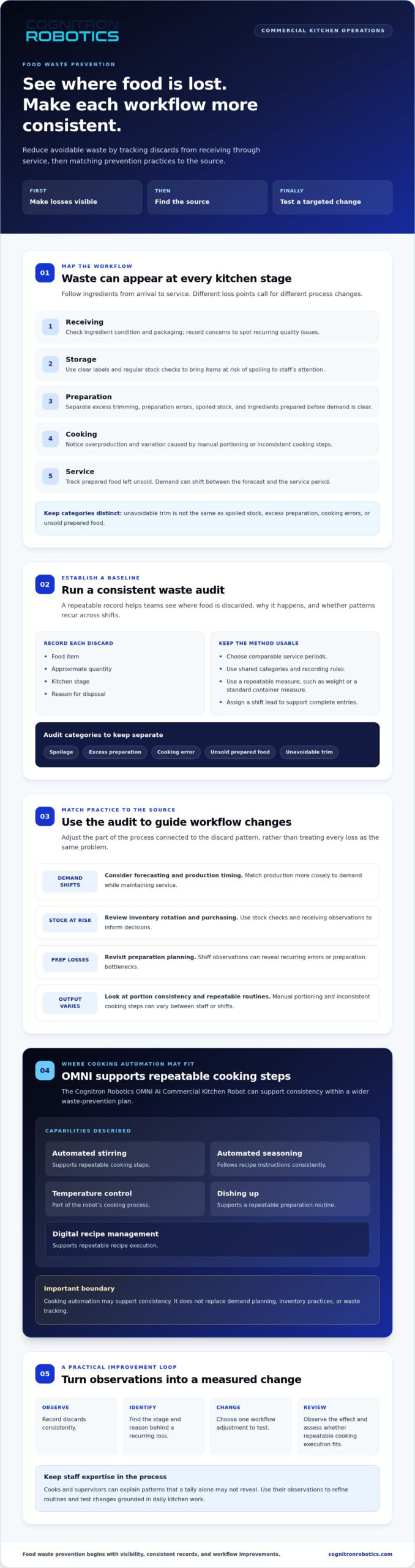
This guide explains how to track waste across kitchen workflows and build prevention habits for purchasing, preparation, and batch cooking. It also explores how cooking automation may support consistency. The Cognitron Robotics OMNI AI Commercial Kitchen Robot automates stirring, seasoning, temperature control, and dishing up, while digital recipe management supports repeatable recipe execution. These capabilities can contribute to a broader waste-prevention plan, but they don’t replace demand planning, inventory practices, or waste tracking.
Key Takeaways
- Map potential waste points from receiving and storage through preparation, cooking, and service to identify where closer attention may help.
- Establish a baseline by recording discarded food consistently by category, kitchen stage, and reason.
- Match prevention practices to the source of waste, using forecasting, inventory rotation, preparation planning, portion consistency, and production timing.
- Minimizing food waste in commercial kitchens starts with workflow improvements. Cooking automation may support repeatable preparation, but it can’t replace sound purchasing and planning.
- Use an audit to choose one change, observe its effect, and assess whether OMNI’s repeatable stir-frying and recipe execution suit your kitchen.
Where Food Waste Starts in Commercial Kitchens
Minimizing food waste in commercial kitchens is an operational practice, not a single equipment purchase. Waste can start before cooking, when ingredients arrive in poor condition or remain unused in storage, and continue through preparation, cooking, and service. Map each stage to distinguish avoidable losses from scraps that are part of food preparation. For a broader overview of what is food waste, see this reference.
For a practical look at waste prevention in a restaurant setting, watch this video:
Which kitchen stages can create avoidable waste?
At receiving, check ingredient condition and packaging, and record concerns so recurring quality issues are easy to identify. In storage, clear labels and regular stock checks help staff find items at risk of spoiling before they’re forgotten. Use those observations to inform purchasing and preparation decisions.
Preparation waste can occur when staff remove more usable material than a recipe requires or prepare ingredients before demand is clear. Some trim is unavoidable, but spoiled stock, preventable preparation errors, and food prepared but never served point to different process issues. Record these separately instead of grouping all scraps together.
Cooking and service provide further clues. Overproduction means preparing more than demand calls for; unsold prepared food is what remains at the end of service. Neither is the same as unavoidable peelings or other inedible scraps. Separating these categories helps teams decide whether planning, preparation, or service routines need attention.
Why do busy service periods make prevention harder?
Demand can shift between forecast and service. A rush may call for faster production, while a quieter period can leave prepared food unsold. Teams must balance quick service with producing only what is needed. Manual portioning or inconsistent cooking steps can also cause output to vary between staff members or shifts.
Staff knowledge is essential. Cooks and supervisors can recognize patterns that a tally alone won’t explain, such as a recurring preparation bottleneck or a menu item that is routinely left over. Use their observations to adjust routines and test changes. Their input helps turn waste prevention into a shared workflow grounded in what actually happens in the kitchen.
How to Measure Food Waste Before Choosing Solutions
Before changing a process or investing in technology, establish a clear baseline. A consistent audit can show where food is discarded, what may be causing it, and whether the same issue appears across shifts. This gives your team evidence to guide action instead of relying on impressions. Harvard T.H. Chan School of Public Health outlines several causes of food waste; in a commercial kitchen, recording the reason for each discard helps connect those causes to daily workflows.
How can a kitchen run a useful waste audit?
Choose an observation period that includes comparable service periods, then apply the same recording rules throughout. Assign a lead on each shift to check that entries are complete and categories are used consistently. Record an approximate quantity using a repeatable method, such as weight or a standard container measure. Consistency matters more than precision that staff can’t maintain.
For each discarded item, note the food, quantity, workflow stage, and reason. Keep categories distinct, such as spoilage, excess preparation, cooking error, unsold prepared food, and unavoidable trim. A concise audit checklist:
- Set the scope: Choose the observation period, shifts, and recording method.
- Use shared categories: Define disposal reasons so staff record similar events the same way.
- Log each discard: Note the item, approximate quantity, kitchen stage, and reason.
- Assign ownership: Name a shift lead to support complete, consistent entries.
- Review comparable periods: Compare similar service days or periods, not unlike workloads.
How should operators use the audit findings?
Look for repeated patterns. The same ingredient discarded during storage may point to a different issue than repeated over-preparation before service. Sort observations by food item, shift, kitchen stage, and reason, then consider them alongside service demand. Staff comments can explain patterns, especially when the record shows what happened but not why.
Don’t redesign the workflow around one unusual incident. Check whether the issue recurs under comparable conditions, then choose a targeted change, such as adjusting preparation timing for a particular item. Record the same information during a later comparable period. Avoid setting a universal target before establishing your baseline; the useful comparison is whether the pattern changes under your own operating conditions.
A reliable baseline also helps you judge whether a process change or cooking technology addresses the issue you observed. If repeatable cooking steps are under consideration, discuss your kitchen’s requirements with Cognitron Robotics as part of evaluating suitability.
Which Food-Waste Prevention Practices Fit Your Kitchen Workflow?
Choose prevention practices based on the waste pattern your kitchen has observed, not a universal ranking. Spoilage calls for different action than excess preparation or inconsistent portions. Connect each change to its likely cause, then check whether it fits your menu, service rhythm, staffing, and food-safety procedures. This makes minimizing food waste in commercial kitchens a focused operating decision rather than a collection of disconnected tactics.
How can planning and inventory practices prevent avoidable waste?
Use menu and service records to guide purchasing and preparation. If demand for an item varies by day or service period, review those patterns before setting preparation quantities. Compare planned amounts with actual menu use and audit findings. This helps teams adjust what they order, prepare, and hold ready instead of relying on a fixed quantity for every shift.
Consistent stock rotation and routine storage checks help staff identify ingredients that need attention and prioritize their use. Keep rotation practices clear across shifts and align them with the kitchen’s established food-safety procedures. Preparation plans should also identify which ingredients can be prepared closer to service instead of automatically processing everything in advance.
- Recurring spoilage: Review ordering, stock rotation, and storage checks.
- Excess prepared ingredients: Revisit preparation timing and quantities against menu use.
- Unpredictable demand: Compare service patterns and adjust forecasts for relevant periods.
When do portion control and batch cooking help?
Portion control is useful when servings vary between staff members or shifts. Clear portion standards and consistent serving methods can reduce variation, supporting more predictable production and guest expectations. Check whether portion differences appear in the audit before changing a recipe or service routine.
Batch cooking means cooking multiple portions together during one production cycle. It can suit dishes with steady demand, but a large batch may leave more prepared food unsold if orders slow. Set batch size and timing according to observed demand, menu requirements, available staffing, and safe operating procedures. For items with less predictable orders, smaller or more frequent batches may be worth testing if they fit the kitchen’s process.
These practices work together: forecasting guides how much to prepare, inventory rotation helps teams use stock in a planned sequence, portion standards shape serving size, and production timing connects the plan to service. Test changes against comparable operating periods and review the observations before making them routine. No single practice guarantees a particular result, but matching actions to a verified waste source gives the team a practical basis for improvement.
How to Make Cooking Processes More Consistent Without Losing Staff Expertise
Cooking automation can support consistent execution, but it can’t correct inaccurate purchasing, weak demand forecasts, or poor stock rotation on its own. Those decisions still depend on kitchen planning and staff knowledge. For minimizing food waste in commercial kitchens, treat automation as one part of the workflow, not a substitute for understanding why ingredients are discarded.
What can standardized cooking steps improve?
A documented recipe gives staff a shared reference for ingredients, sequence, and cooking instructions across shifts. It can make handovers clearer and help teams identify when results differ from the intended process. Experienced cooks still bring judgement: they can assess ingredient condition, respond to service needs, and flag when a recipe or routine needs review.
For suitable dishes, the BOTINKIT OMNI AI Commercial Kitchen Robot can automate stirring, seasoning, temperature control, and dishing up. These repeatable steps may support consistent recipe execution, but they don’t establish that food waste will decrease. Staff remain responsible for decisions such as what to prepare, how much to produce, and whether the dish meets kitchen standards.
What should operators assess before automating cooking?
Start with the menu and tasks. Confirm that the dishes and cooking methods you want to automate fit the system’s capabilities, and consider whether batch cooking suits actual demand. OMNI supports batches of up to 30 portions. Match the batch plan to service patterns rather than assuming every dish should be produced in the same quantity.
Then assess the technical environment and day-to-day workflow. Review the proposed location, available utilities, ventilation, cleaning requirements, and how staff will move around and work with the system. OMNI’s listed dimensions are 1769 mm high, 827 mm wide, and 920 mm deep. Confirm the technical requirements for the proposed setup with the supplier before planning installation. Include safety procedures and operator training in implementation planning so the team understands responsibilities, process controls, and when to intervene.
A manual-versus-automated comparison is most useful when it focuses on the task, not on replacing one approach wholesale:
- Manual cooking: Staff apply direct judgement and can adapt in the moment, while results may vary between people or shifts.
- Automated cooking: Programmed steps can be repeated for suitable recipes, while staff oversee ingredients, production decisions, safety, and quality.
Assess the BOTINKIT OMNI Commercial Kitchen Robot against your recipes, workflow, and technical requirements. Contact Cognitron Robotics to discuss whether OMNI fits your kitchen.
Build a Food-Waste Reduction Plan and Assess Where OMNI Fits
A practical plan turns waste observations into controlled changes. Start with your audit, identify a recurring pattern, test one adjustment, then review what happened with the staff who carry out the work. This measured approach helps you assess whether a process change is useful before making it routine. Minimizing food waste in commercial kitchens depends on matching the response to the cause, not assuming one tool will solve every issue.
How can a kitchen test and refine its prevention plan?
Choose one repeated finding, such as a dish often left unsold or ingredients consistently prepared too early. Define a specific change, such as shifting preparation closer to service or adjusting a production step. Keep recording the same food categories, stages, reasons, and quantities used in your baseline audit so observations before and after the change are easier to compare.
Review the results with kitchen staff. Ask whether the adjustment fit the service rhythm, affected other tasks, or revealed a different cause. If the pattern remains, refine the process and continue tracking. If it changes, check whether the result holds across comparable shifts before adopting the adjustment more widely.
Where can OMNI support a consistent cooking workflow?
OMNI may be worth assessing when repeatable stir-frying and recipe execution matter to your operation. The BOTINKIT OMNI AI Commercial Kitchen Robot supports automated seasoning, stirring, temperature control, auto dishing up, and digital recipe management. These functions can help standardize cooking steps for suitable dishes. They don’t forecast demand, manage inventory, or establish a reduction in food waste; staff still plan production, monitor results, and apply their kitchen expertise.
OMNI supports up to 30 portions per batch. Assess that capacity against your menu and observed demand, then confirm that the cooking tasks suit the system. Include kitchen layout, staff workflow, cleaning needs, safety procedures, and operator training in your evaluation. Check utility requirements with the supplier and a qualified professional. Confirmed specifications include 220 V, 3-Phase, 5-wire; MAX electrical power of 12 kW (24 A) and 15 kW (30 A); and 2 kW per OMNI unit. Water pressure is 200-350 kPa, and hood exhaust air volume must be greater than 3000 m³/h per OMNI unit. Confirm which specifications apply to the proposed setup before planning implementation.
Keep decisions grounded in evidence: audit the workflow, prioritize a recurring issue, test one process change, and review comparable observations with staff. If repeatable cooking steps are part of your assessment, contact Cognitron Robotics to discuss OMNI’s capabilities and your kitchen’s technical requirements.
Turn Your Waste Audit Into Consistent Action
Minimizing food waste in commercial kitchens starts with visibility. Track discarded food by item, kitchen stage, and reason, then use recurring patterns to decide what to change. Forecasting, stock rotation, preparation timing, and portion standards address different causes, so choose practices that fit your menu and service.
Test one adjustment at a time and compare observations from similar service periods. Staff knowledge remains essential: their feedback helps explain what the records show and whether a new routine works in practice.
Cooking automation can support repeatable execution, but it doesn’t replace purchasing decisions or demand planning. Cognitron Robotics provides the BOTINKIT OMNI AI Commercial Kitchen Robot, which features automated seasoning, automated stirring, temperature control, and digital recipe management. These capabilities support consistent cooking processes without guaranteeing waste reductions.
Contact Cognitron Robotics to discuss whether OMNI fits your kitchen’s workflow and review its suitability for your recipes and operating requirements. With a measured plan and the right support for your team, you can make informed progress.
Frequently Asked Questions
How can a commercial kitchen reduce food waste?
Start by tracking discarded food, then address the recurring causes your records reveal. Minimizing food waste in commercial kitchens can involve matching purchasing and preparation to menu demand, rotating stock consistently, setting clear portion standards, and adjusting production timing. Test one change at a time and review comparable service periods. Staff observations also help explain why food is discarded and whether a new routine fits the kitchen’s workflow.
What are the main causes of food waste in commercial kitchens?
Common causes include spoilage, overproduction, inconsistent portions, and preparation errors. Waste can occur at several stages: ingredients may deteriorate in storage, usable food may be lost during trimming, or prepared dishes may remain unsold after service. Separate unavoidable scraps from avoidable losses in your records. That distinction helps identify whether a recurring issue calls for changes to purchasing, inventory practices, preparation, or production planning.
How do you measure food waste in a restaurant kitchen?
Run a defined audit and use the same recording rules across shifts. For every discard, record the food item, approximate quantity, kitchen stage, and reason, such as spoilage, excess preparation, cooking error, or unsold prepared food. Assign a shift lead to support consistent entries. Compare observations from similar service periods, then look for repeated patterns by item, stage, shift, and demand before changing procedures.
Can batch cooking help reduce food waste?
Batch cooking can support planned production, but it doesn’t automatically prevent waste. Cooking multiple portions in one production cycle may suit dishes with steady demand; producing too much can leave prepared food unsold if orders slow. Set batch size and timing using observed demand, menu needs, staffing, and safe operating procedures. Track what remains after service and adjust the next production cycle based on comparable observations.
Can an AI-powered cooking robot reduce food waste?
An AI-powered cooking robot may support repeatable cooking steps, but that alone doesn’t establish or guarantee lower food waste. The BOTINKIT OMNI AI Commercial Kitchen Robot features automated seasoning, automated stirring, temperature control, auto dishing up, and digital recipe management. These capabilities can support consistent recipe execution for suitable dishes. Teams still need to manage purchasing, forecast demand, rotate stock, and decide how much to prepare.
What should a kitchen assess before installing a commercial cooking robot?
Check that the dishes and cooking tasks suit the system, then review the kitchen layout, workflow, utilities, ventilation, cleaning needs, safety procedures, and operator training. For OMNI, confirmed electrical specifications include 220 V, 3-Phase, 5-wire; MAX electrical power of 12 kW (24 A) and 15 kW (30 A); and 2 kW per unit. Water pressure is 200-350 kPa, and hood exhaust air volume must be greater than 3000 m³/h per unit. Confirm the applicable setup requirements with the supplier before planning installation.
Does OMNI guarantee lower food waste?
No. Cognitron Robotics does not establish a guaranteed food-waste reduction from OMNI. Its confirmed cooking capabilities, including automated stirring, automated seasoning, temperature control, and digital recipe management, can support repeatable execution, but they don’t replace demand forecasting, inventory rotation, or waste tracking. To assess whether the system fits your kitchen, review your audit findings, recipes, workflow, and technical requirements alongside its capabilities.