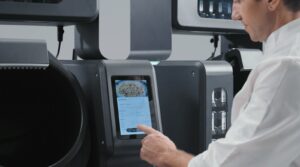
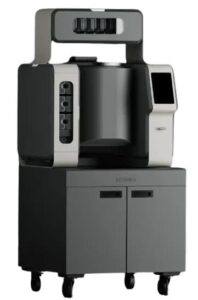
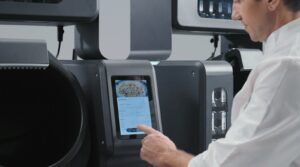
What if the same dish could reach the pass with a consistent flavour and finish, even when staffing changes between shifts or locations? Robotic cooking for food service can make repeatability part of the process. For restaurant operators, manual seasoning and repetitive cooking tasks can make it harder to maintain quality during a rush or across multiple locations.
Automation does not remove the need for skilled people. It can take on defined cooking tasks while kitchen teams focus on quality checks, recipe development and service. The BOTINKIT OMNI AI Commercial Kitchen Robot automates stir-frying, seasoning and cleaning, with digital recipe management to help teams follow consistent cooking instructions. That gives operators a practical starting point for assessing how automation could fit their kitchen workflow.
This implementation guide explains how to assess kitchen needs, prepare the technical environment and integrate robotic cooking into daily operations. It covers recipe setup, team training, site requirements and ways to evaluate whether automation is addressing a real service bottleneck. Cognitron Robotics provides the BOTINKIT OMNI in Canada.
Key Takeaways
- Identify repetitive cooking tasks that robotic cooking for food service could standardize, while staff retain responsibility for oversight and service.
- Use digital recipe management to give kitchen teams consistent cooking instructions, then test and approve recipes before adopting them across locations.
- Assess your kitchen’s technical environment before implementation, including the recommended 220 V, 3-Phase, 5-wire electrical box configuration.
- Review the product’s listed certifications and confirm that the unit and site meet your operation’s requirements.
- Plan batch production around the recipe and portion size. OMNI supports single servings up to 30 portions at once.
What is Robotic Cooking for Food Service?
Robotic cooking for food service uses an automated system to carry out defined preparation tasks in a professional kitchen. Rather than having a team member continuously stir a wok or add every seasoning by hand, the system follows programmed cooking instructions. This repeatability can help a kitchen manage busy service and follow a consistent process from shift to shift.
The idea fits within the broader automated restaurant model, but cooking robots address a specific back-of-house need: preparing food through repeatable steps. Automation varies by product, so check which cooking functions, equipment and recipe controls are included. Do not assume a system performs tasks that are not listed for that model.
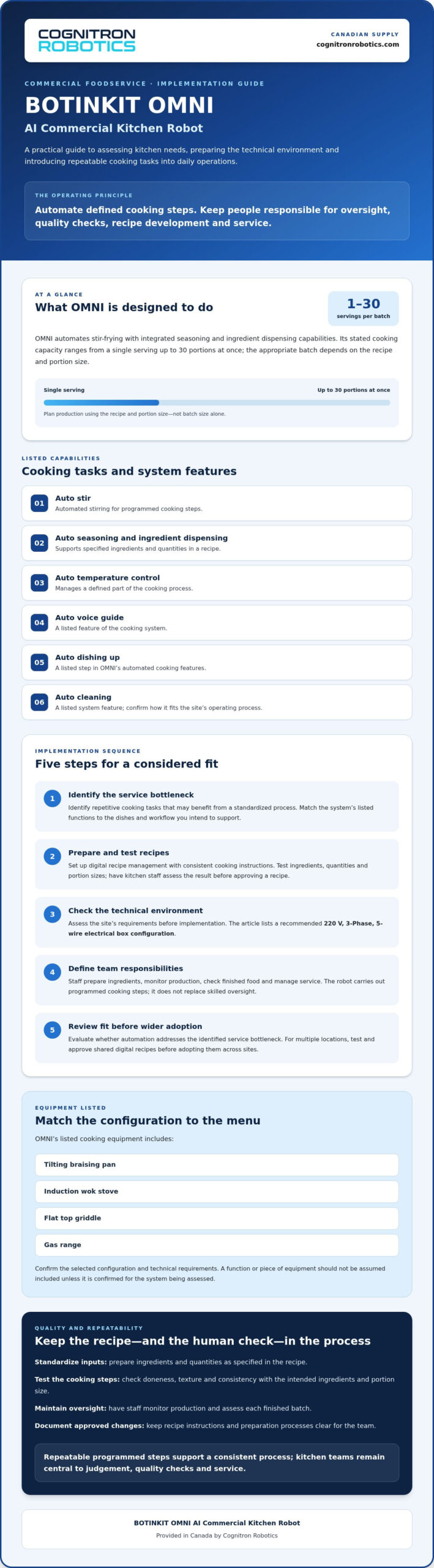
The BOTINKIT OMNI automates stir-frying with integrated seasoning and ingredient dispensing capabilities. It also includes features such as auto temperature control, auto voice guide, auto dishing up and auto cleaning. Digital recipe management helps teams follow consistent instructions. Explore the BOTINKIT OMNI cooking robot.
The Rise of Cobotics in Canadian Kitchens
Cobotics describes people and robots working alongside one another. In a kitchen, a system can carry out programmed cooking steps while staff remain responsible for oversight, ingredient preparation and checking the finished dish. This approach keeps people involved in work that calls for judgement, while automation handles defined, repeatable tasks.
For operators with multiple locations, a shared digital recipe can give teams the same cooking instructions to follow. Staff still need to prepare ingredients as specified, monitor the process and check the result. Establishing those responsibilities before introducing a robot helps the team understand where automation fits into the existing workflow.
Key Components of Automated Cooking Systems
When comparing systems, check the specific functions rather than relying on a general label such as “cooking robot.” OMNI lists auto seasoning, auto stir, auto temperature control, auto voice guide, auto dishing up and auto cleaning. Its listed cooking equipment includes a tilting braising pan, induction wok stove, flat top griddle and gas range.
Match the equipment and functions to the dishes you intend to prepare. Consider how ingredients will be staged, which steps are automated and where staff need to monitor or finish the dish. Confirm the selected configuration and technical requirements before planning installation. A feature should not be treated as included unless it is confirmed for the system being assessed.
The Mechanics of an AI-Powered Cooking Robot
An AI-powered cooking robot coordinates programmed steps to help teams repeat preparation with less continuous manual work. In a busy kitchen, the practical questions are how the system handles cooking, seasoning and other defined tasks, and how staff will supervise production. Robotic cooking for food service can support consistent execution, but people remain responsible for checking the food and managing the wider service flow.
OMNI automates stir-frying and includes auto seasoning, auto temperature control and auto cleaning among its listed features. Its cooking capacity supports a single serving up to 30 portions at once. The appropriate batch depends on the recipe and portion size, so use the product’s documented capacity examples when planning production rather than assuming every dish can be prepared in the same quantity.
Automated Stirring and Temperature Control
Auto stir and auto temperature control are designed to manage parts of the cooking process that otherwise require close, continuous attention. Before using a dish in service, test the programmed steps with the ingredients and portion size your kitchen intends to use. Check the result for doneness, texture and consistency, and document any approved changes to the recipe or preparation process.
Batch size alone does not determine the finished result. Ingredient preparation and the recipe instructions also matter. Keep those inputs consistent, monitor the cooking process and have staff check finished batches. This gives the team a clear role in quality control while the robot carries out programmed cooking steps.
Precision Seasoning and Ingredient Dispensing
OMNI includes auto seasoning and ingredient dispensing capabilities. When setting up a recipe, confirm the specified ingredients and quantities, and check that the team can prepare and load them consistently. A defined process can help reduce differences caused by manual additions, but the recipe still needs to be tested and reviewed by kitchen staff.
For each menu item, document the approved ingredient preparation, portion size and cooking instructions. If a recipe changes, test the revised version before using it as the shared standard. Automated dispensing follows the programmed recipe; staff remain responsible for ingredient quality and checking the finished dish.
OMNI also lists an auto voice guide, auto dishing up and auto cleaning. Treat the voice guide as workflow support, not a substitute for staff training or supervision. Auto cleaning is a product feature, but it does not remove the need to follow the product’s cleaning instructions and your kitchen’s established food-safety procedures.
For a practical view of human-technology collaboration and how AI can help with kitchen bottlenecks, consider how automation fits your team’s actual service flow. To review OMNI’s confirmed functions for your kitchen, contact the Cognitron Robotics team.
Standardizing Quality with Digital Recipe Management
Digital recipe management gives kitchen teams a shared reference for ingredients, quantities and cooking steps. OMNI uses digital recipe management to help maintain consistent flavour profiles across dishes prepared in professional kitchens. For an operator with multiple locations, shared instructions can reduce reliance on each shift interpreting a recipe from memory.
Robotic cooking for food service works best when recipe setup is treated as an operational standard, not a one-time upload. Organize recipes so staff can find the correct version, confirm that ingredient preparation and portioning match the instructions, and have the kitchen team review the result before adopting it. The system follows programmed steps; people still assess flavour, presentation and customer feedback.
Recipe Reproduction and Consistency
Consider a signature stir-fry prepared by different teams. If each cook measures and seasons by eye, small differences can build up between shifts. A digital recipe can provide a defined sequence for the team to follow. Staff still need to use the specified ingredients, prepare them consistently and check the finished dish against the kitchen’s standard.
Consistent recipe instructions can also support staff training. New team members can learn a documented process instead of relying only on informal demonstrations. Training remains essential: employees need to understand ingredient loading, recipe selection, monitoring and quality checks before using the system during service.
Adapting International Cuisines for Automation
OMNI’s documented cuisine examples include Italian dishes such as Carbonara, Thai Pad Thai, Korean Tteok-bokki, Indian Butter chicken, Mediterranean Spanakorizo, Tex-Mex Beef Taco Meat and Chinese Sweet and Sour Chicken. These examples show a range of dishes, but they do not mean every recipe is suitable for every kitchen or configuration.
Before adding a dish to a production menu, test its ingredients, portion size and cooking sequence under the intended operating conditions. Check the result with kitchen staff, then document the approved process so the team has a clear reference. This allows automation to support repeatable execution while people retain oversight of the finished dish.
For foodservice operators, the BOTINKIT OMNI cooking robot offers digital recipe management alongside automated cooking functions. Keep the recipe library aligned with current menu specifications, and review changes with the team before using them in service.
How to Implement Robotic Solutions in a Commercial Kitchen
Plan implementation around the unit’s technical requirements and your kitchen’s existing layout. Before installation, document available utilities, ventilation capacity, staff access and ingredient placement. Compare the site with the specifications for the intended OMNI configuration, and have qualified professionals assess the infrastructure. This can identify site-readiness issues before they affect kitchen operations.
Technical Environment and Infrastructure Requirements
The recommended electrical box configuration is 220 V, 3-Phase, 5-wire. The product information lists maximum electrical power ratings of 12 kW (24 A) and 15 kW (30 A), and 2 kW electrical power per OMNI unit. Confirm the applicable configuration and electrical capacity for your sales area with a qualified electrical professional.
Plan for the specified utilities as well:
- Hood exhaust: greater than 3000 m³/h per OMNI unit.
- Water pressure: 200–350 kPa.
Have ventilation and plumbing professionals assess whether the site can meet these specifications. Include connections, drainage and equipment placement in the review, then confirm readiness before installation. The product’s physical dimensions are 1769 mm high, 827 mm wide and 920 mm deep, which can help inform layout planning. Check the proposed position and surrounding work area with the appropriate site professionals.
Safety Certifications and Compliance
The listed certifications include USA and Canada (NA), NSF/ANSI 4, CE, FCM and RCM. Review the documentation for the specific unit and configuration, and confirm that it meets your facility’s requirements. A product certification should not be treated as automatic approval for every site or as a substitute for any additional review your operation requires.
Before launch, document operating and cleaning procedures, assign staff responsibilities, and train the team on recipe selection, ingredient loading, cycle monitoring and fault reporting. Auto cleaning is a listed function, but staff should still follow the product’s cleaning instructions and the kitchen’s established food-safety procedures.
Use a site-readiness review to align your technical team, kitchen staff and equipment supplier before installation. Contact Cognitron Robotics to review OMNI requirements for your kitchen.
Optimizing High-Volume Operations with BOTINKIT OMNI
During a peak, cooking capacity matters when it fits the full service workflow. OMNI supports single servings up to 30 portions at once. Its documented Carbonara example gives specific batch sizes and cooking times, but these timings apply to that example, not every recipe. Ingredient preparation, recipe steps and kitchen flow also shape the work involved in serving an order.
For robotic cooking for food service to address a bottleneck, decide which menu items are suitable for batch production and how staff will prepare, load and finish them. Assign clear roles for ingredient staging, recipe selection and quality checks. The robot can handle programmed cooking tasks while team members coordinate orders, inspect dishes and manage the pass.
Batch Cooking and Speed of Service
Start with a menu item that involves repeated manual work, such as a high-volume stir-fry. Map its current preparation steps, then test the programmed process under representative service conditions. Record the measures that matter to your operation, such as preparation time, finished-dish consistency, ingredient use and staff involvement. This gives you a basis for deciding whether the system addresses the constraint you identified.
Cooking speed alone does not determine table turnover. Seating, ordering, payment and table resetting also shape how quickly a restaurant serves guests. BOTINKIT’s Digital Kitchen Solution describes KMES and OMNI together as an AI-powered Kitchen Manufacturing Execution System, and states that KMES doubles peak-hour table turnover. Treat this as a stated system claim, not a guaranteed result for every operation. Assess your own service flow and conditions when considering potential outcomes.
Planning a Rollout with Cognitron Robotics
Cognitron Robotics provides the BOTINKIT OMNI AI Commercial Kitchen Robot for commercial food preparation environments. When assessing a rollout, confirm the support process and technical requirements for your sites rather than assuming a particular service schedule or parts availability.
Build a rollout plan that fits your operation: select a representative kitchen, confirm its technical readiness, train the team and review the process before expanding. Compare results against your own baseline, including batch output, order timing, recipe consistency and staff workload. This helps determine whether the system supports your service targets without assuming a fixed labour reduction or table-turnover increase.
Review the BOTINKIT OMNI cooking robot and assess how its documented capacity and automated cooking functions fit your menu, facilities and peak-hour workflow. If you want to separate realistic capabilities from common overclaims before committing to a rollout, the guide to precision cooking myths and realities for commercial kitchen cooking robots covers what automation can and cannot do in day-to-day operations.
Put Consistent Cooking into Practice
Robotic cooking for food service can give commercial kitchens a repeatable way to manage defined preparation tasks and follow recipe standards. A strong implementation starts with a clear operational goal, a site that can meet the technical requirements, and staff who remain involved in training, oversight and quality control.
The BOTINKIT OMNI AI Commercial Kitchen Robot automates stir-frying and seasoning, and includes an auto cleaning function. Its digital recipe management is designed to help maintain consistent flavour profiles across prepared dishes. More than 6,000 units have shipped.
Ready to assess how OMNI could fit your menu, facilities and service workflow? Contact Cognitron Robotics to discuss the BOTINKIT OMNI and review the next steps for your kitchen.
Frequently Asked Questions
How many portions can a robotic cooking system prepare at once?
OMNI supports single servings up to 30 portions at once. The suitable batch size depends on the recipe and serving size. For the documented Carbonara example, a 20-portion batch is 8 kg. Treat the maximum as a capacity limit, not a recommendation to cook every dish in the largest batch.
Does robotic cooking for food service meet Canadian food safety standards?
The listed certifications include USA and Canada (NA) and NSF/ANSI 4. Review the documentation for the specific unit and configuration, and confirm that it meets your facility’s requirements. A certification does not automatically confirm that every installation meets all site-specific requirements. Continue to follow your kitchen’s food-safety procedures during operation and cleaning.
What are the electrical requirements for the BOTINKIT OMNI in Canada?
The recommended electrical box configuration is 220 V, 3-Phase, 5-wire. The product information also lists maximum electrical power ratings of 12 kW (24 A) and 15 kW (30 A), and 2 kW per OMNI unit. Have a qualified electrical professional confirm the configuration for your installation. This product supports the electrical requirements of different countries and regions; specific specifications may vary by sales area.
Can an AI-powered cooking robot reduce my restaurant’s labour costs?
An AI-powered cooking robot can take on programmed tasks such as stir-frying and seasoning, which may change how much continuous manual work those steps require. The effect on labour costs depends on your menu, staffing plan, service volume and how you organize kitchen roles. Automation supports staff rather than replacing their oversight. Assess your workflow and measure results at your operation before forecasting savings.
How long does it take to cook a large batch of food with a robotic chef?
For the documented Carbonara example, OMNI prepares 8 kg, or 20 portions at 400 g each, in 8 minutes. The listed example takes 6 minutes for 4 kg, or 10 portions, and 3 minutes for 400 g, or one portion. These are product examples, not universal timing guarantees. Ingredient preparation and the wider kitchen workflow also affect service timing.
Is it possible to standardize recipes across multiple restaurant locations?
OMNI’s digital recipe management helps teams follow consistent cooking instructions. Operators can organize approved recipes and train staff to use the same programmed process. Staff should still check ingredient preparation and finished dishes. Test recipes in the intended kitchen before adopting them as a shared operating standard.
What kind of maintenance do automated cooking systems require?
OMNI includes an auto cleaning function, but staff must still follow the product’s cleaning and maintenance instructions. Train the team on the required cleaning process, routine checks and how to report a fault. Confirm the maintenance requirements and support process in the product documentation. Follow the instructions for the specific system and its use in your kitchen.
Do I need a special ventilation hood for a commercial kitchen robot?
Confirm hood capacity and compatibility before installation. The OMNI product information specifies hood exhaust air volume greater than 3000 m³/h per unit. Have your kitchen’s ventilation professional assess the existing hood and proposed setup against this requirement and the site conditions. Do not assume an existing hood is adequate based on its presence alone. Verify the requirements for the specific configuration before planning the work.